When someone asks AI to recommend a service, competitors show up — but you don't. Genview's competitor analysis makes the gap between you and your competitors in AI visible in numbers, so you can understand your position and identify exactly where to improve.
What You Learn from Competitor Analysis
① Your relative position within your industry
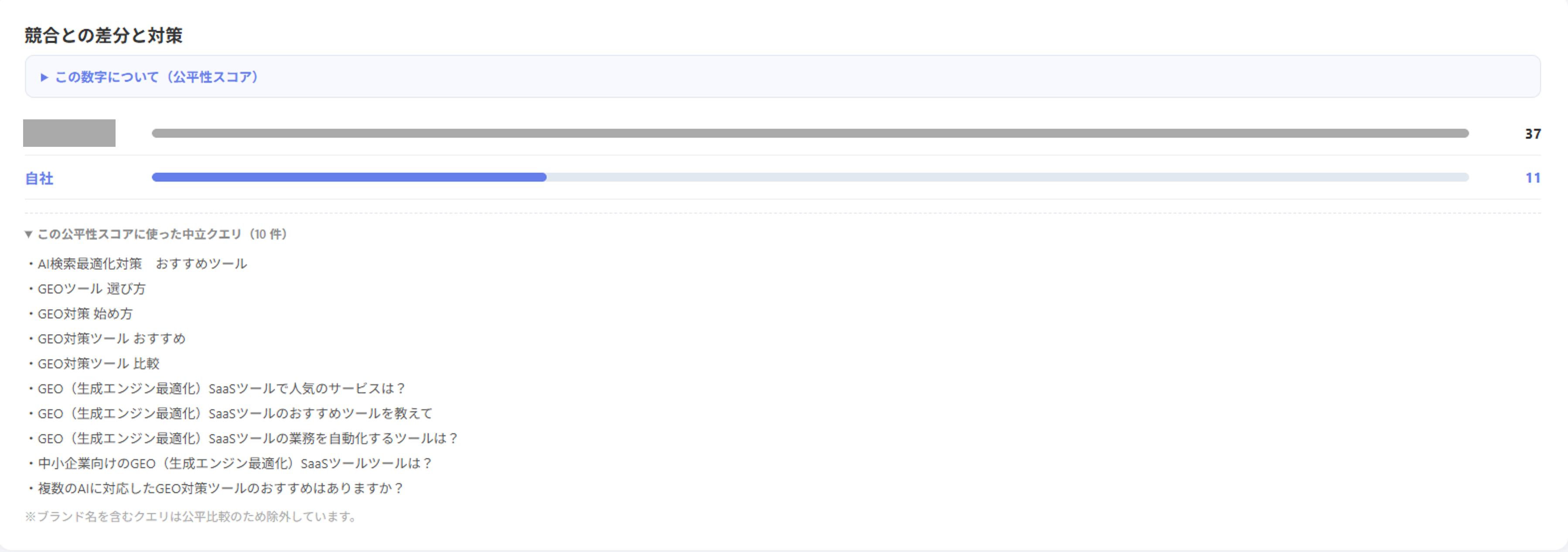
See your Fairness Score and your competitors' scores side by side. "Competitor scores 37, we score 11" — the gap in AI presence becomes visible in numbers.
② See the neutral queries used for scoring
You can review the 10 neutral queries used to calculate the Fairness Score — queries like "GEO tool comparison" and "how to choose a GEO tool" that contain no brand names.
③ Register neutral queries to track changes over time
The neutral queries used in the Fairness Score can be added to your query settings as ToFu, MoFu, or BoFu queries, allowing you to continuously monitor how your appearance on those queries changes over time.
Why Competitor Comparison Is Hard in AI
SEO had a clear metric: search ranking. You could see your position and your competitors' positions at any time. GEO doesn't have that.
AI responses change by day and by query. Even if you believe your product is superior, it's not uncommon for competitors to be consistently recommended while you're left out.
The SEO era
Rank tracking tools showed your position and competitors' positions side by side. "Competitor is #3, we're #8 for this keyword" — gaps were visible.
The AI era
AI responses fluctuate with no standard benchmark. The situation of "competitors appearing while we don't" is happening, but there was no way to see the gap in numbers.
How Genview Does It: The Fairness Score
Genview uses a measurement method called the "Fairness Score" to compare your brand and competitors on equal terms.
When queries include brand names, companies with higher name recognition tend to have an advantage. Genview uses neutral queries without brand names — so you can compare AI recognition and recommendation status with reduced influence from brand name recognition.
How the Fairness Score works
✗ Brand-name queries
"What's the difference between Genview and Competitor X?" → Brands with higher name recognition tend to have an advantage
✓ Neutral queries (Fairness Score)
"GEO tool comparison" → Scores all brands with reduced brand name influence
Examples of neutral queries used for scoring
Recommended tools for AI search optimization
How to choose a GEO tool
How to start GEO strategy
Recommended GEO tools
GEO tool comparison
Popular GEO (Generative Engine Optimization) SaaS tools
Recommended GEO tools that support multiple AI platforms
10 queries total
* Queries containing brand names are excluded for fair comparison.
* Competitor registration is available on Standard and Pro plans. Up to 3 competitors can be registered.
Fairness Score vs. Overall Score
The Fairness Score uses a different measurement method from the Overall Score, so the numbers will not match.
Overall Score
Scored across all queries including brand queries. Brands with higher name recognition tend to score more favorably. An absolute metric for your brand alone.
Fairness Score
Scored using only neutral queries without brand names. A relative metric for comparing against competitors with reduced brand recognition influence.
The Competitor Analysis Screen
Fairness Score comparison
Displays your Fairness Score and your registered competitors' scores side by side. The neutral queries used for scoring are also visible.
Who This Is For
Competitors are being recommended by AI but your brand isn't showing up
You want to prioritize GEO strategies with clear data to back your decisions
You need to explain your competitive gap to leadership in numbers
You want to identify which neutral queries to focus your GEO efforts on