Note: AI's internal processes are a black box. This article doesn't claim to know whether AI is "searching" or "not searching." Read it as an observation that the response generation process appears to change based on how you ask.
How the Experiment Worked
I asked the same two questions to the same AI:
Pattern ①: Recommended men's sneakers
Pattern ②: Recently recommended men's sneakers
The only difference is the word "recently." I tested both ChatGPT and Perplexity, using guest mode in both cases to eliminate personalization.
Results
ChatGPT
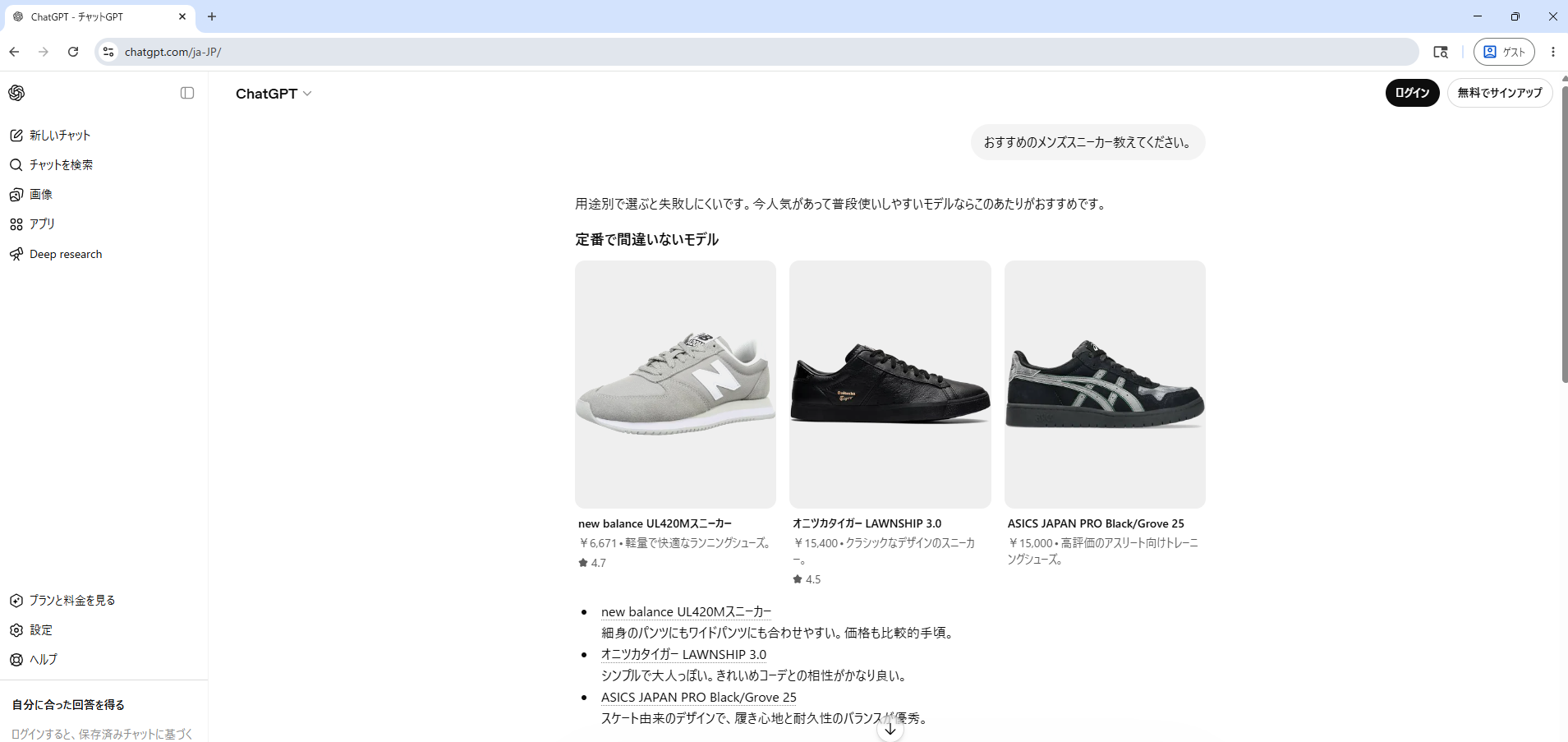
Question ① "Please recommend some men's sneakers."
ChatGPT response to "Please recommend some men's sneakers." (June 2026, guest mode)
No citations shown
Classic brands — New Balance, Onitsuka Tiger, ASICS — dominate
Appears to be answering from trained knowledge alone
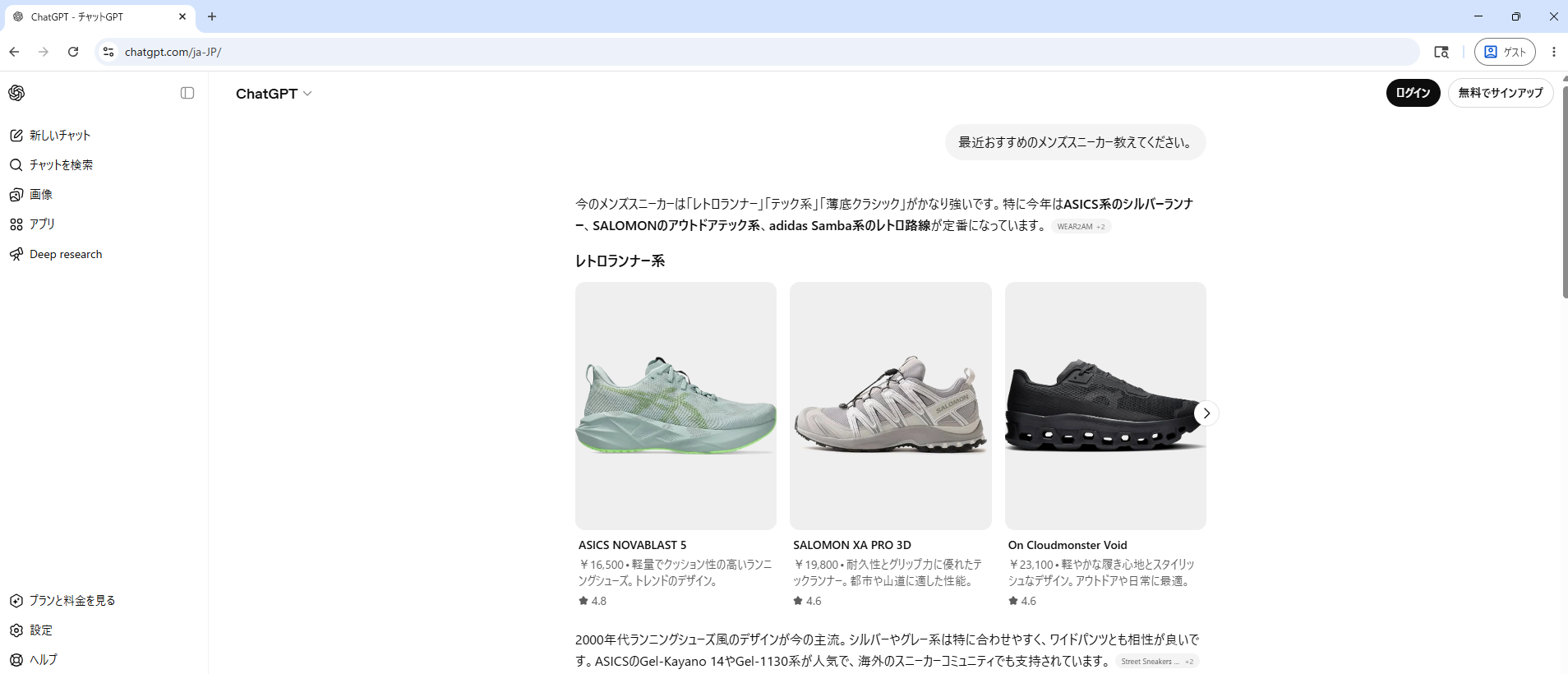
Question ② "Please recommend some men's sneakers that are popular recently."
ChatGPT response to "Please recommend some men's sneakers that are popular recently." (June 2026, guest mode)
Citations appeared — "WEAR2AM +2," "Street Sneakers +2"
Trend-forward models appeared — ASICS NOVABLAST, SALOMON, On
Appears to be retrieving external web information
Testing with Perplexity
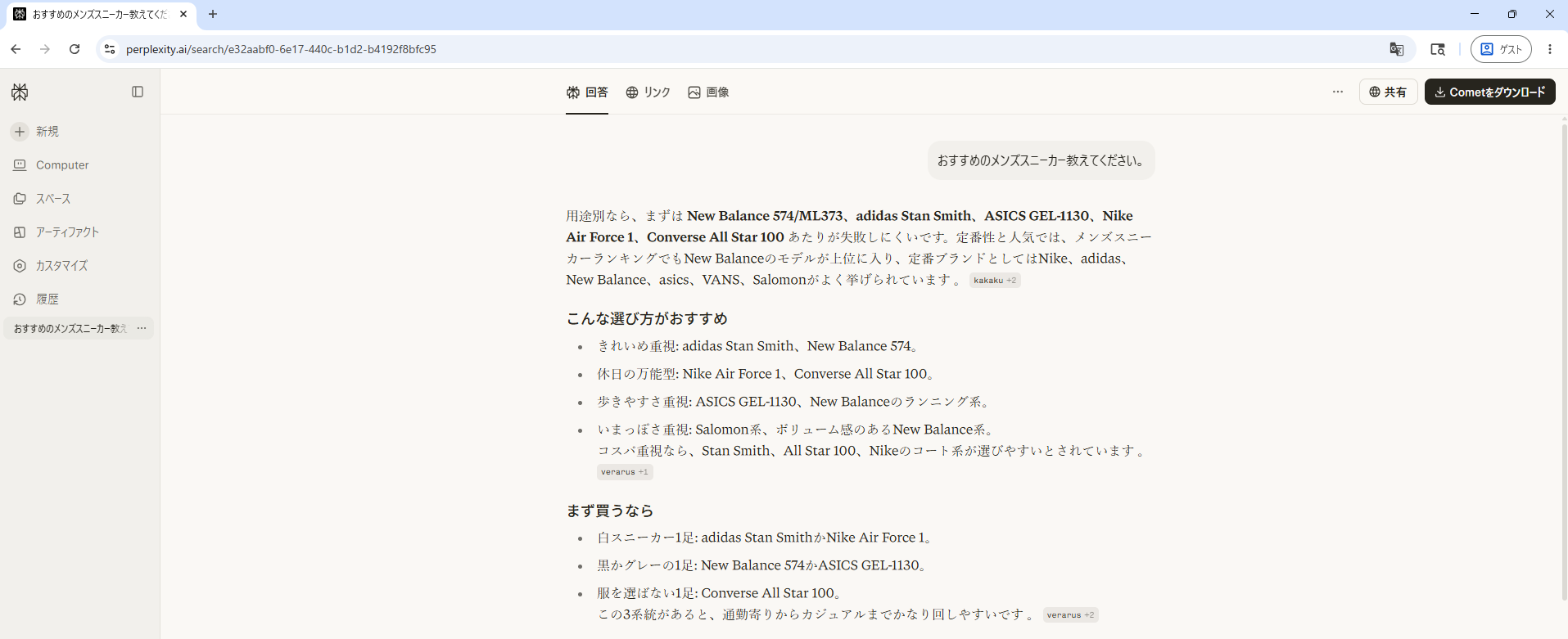
Question ① "Please recommend some men's sneakers."
Perplexity response to "Please recommend some men's sneakers." (June 2026, guest mode)
Citations present from the start — Perplexity always retrieves from the web
Sources: kakaku, verarus — review and comparison media
Classic brands — New Balance, adidas, ASICS — dominate
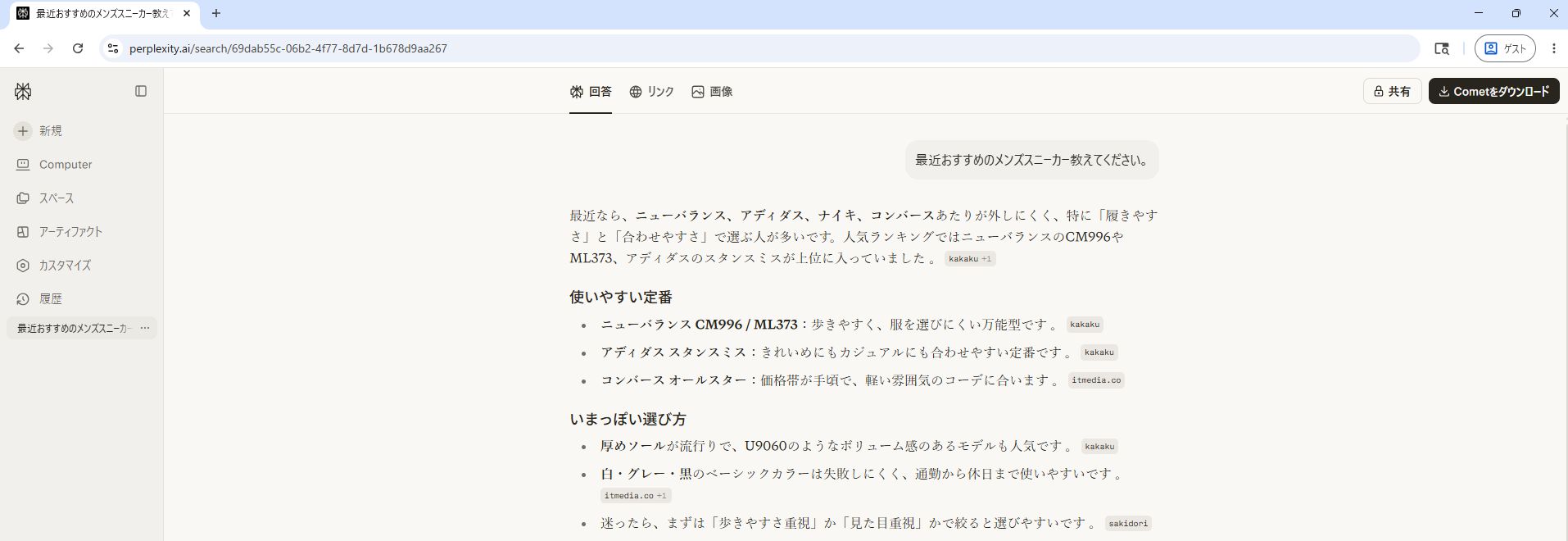
Question ② "Please recommend some men's sneakers that are popular recently."
Perplexity response to "Please recommend some men's sneakers that are popular recently." (June 2026, guest mode)
Citations still present
Sources shifted to kakaku, itmedia, sakidori — trend and new product coverage
Trend-forward models like U9060 appeared
What I Found Interesting
Comparing the two AIs revealed something worth noting.
ChatGPT: No citations for "recommended," citations for "recently recommended." Whether citations appeared at all changed.
Perplexity: Citations appeared for both queries. But the sources changed — review/comparison media for "recommended," trend/new-product media for "recently recommended."
If GEO strategy were simply "add more FAQ pages," you wouldn't expect the AI's behavior to shift this much based on a single word. AI appears to interpret the intent of a question and change what information it retrieves — and where it retrieves it from — accordingly.
What both AIs have in common: AI appears to be seeking the information it needs based on its understanding of the question.
What Appears to Be Happening
In my observation, a question like "recommended sneakers" can be answered from trained knowledge alone. But "recently recommended sneakers" requires current information — and AI appears to respond by retrieving from external sources.
This suggests AI may be interpreting query intent and adjusting its response generation process accordingly. Again — this is a black box. What follows is observation, not conclusion.
Mapping This to Training-Based and RAG-Based Modes
Applying the framework I introduced previously:
"Recommended men's sneakers" → responds from trained knowledge (training-based mode)
"Recently recommended men's sneakers" → retrieves external information (RAG-based mode)
A single word — "recently" — appears to shift AI's information retrieval process.
Does This Mean RAG Optimization Is All You Need?
Seeing this experiment, you might think: "If AI is going to search anyway, I just need to optimize for RAG retrieval." I don't think that's the right conclusion.
Who Interprets the Retrieved Information?
After retrieving external information, AI still has to summarize, compare, and recommend — and that's done by the model itself. Which means:
Eyes = RAG (goes out and gets the information)
Brain = trained model (understands and interprets what it found)
Being able to retrieve content doesn't mean AI can accurately recommend a brand. Even if AI successfully retrieves a recent trend article that mentions your brand, if it doesn't understand who you are and who you serve, it can't place you in the right context for the right recommendation.
What This Means for GEO Strategy
This experiment suggests GEO strategy requires two distinct approaches.
Training-based optimization: Mention frequency, consistency, relevance. Build a consistent, coherent presence across the web so AI can form an accurate concept of your brand.
RAG-based optimization: Crawlability, structure, citability. Make your content easy for AI to find, read, and cite when it retrieves external information.
I believe both "what AI learns about you" and "what AI can easily retrieve about you" are necessary.
Summary
AI appears to change its response process based on how a question is phrased
Queries requiring recency — like "recently recommended" — tend to trigger more external retrieval
Even always-RAG AI like Perplexity changes which sources it retrieves from based on query intent
Being able to retrieve content and being able to understand a brand are different things
GEO strategy requires both training-based and RAG-based optimization