※この記事は、AI検索とSEOの違いをわかりやすく伝えるために一部を意図的に単純化しています。 実際の対策はより多面的な要素が絡みますが、まず「考え方の転換」を掴んでもらうことを優先した内容です。
はじめに
「渋谷 カフェ おすすめ」のようなキーワードをいくつも掛け合わせて、 似たようなページを何枚も量産する——そんなSEO対策に、限界を感じていませんか?
薄いコンテンツのページ量産は、以前に比べて検索エンジンに評価されにくくなってきています。 そして今、AI検索の普及によって「検索意図の捉え方」そのものが変わろうとしています。
今回は、GEO対策の話をするときに必ずといっていいほど聞かれる 「ロングテールキーワードとAI検索の自然文章クエリって何が違うの?」という問いと、 これからのWeb戦略の考え方を解説します。
なお、SEOがGEOに完全に置き換わるという話ではありません。 SEOの土台の上にGEOが乗るイメージが正確で、 基本的なSEO対策は引き続き重要です。
1. 「単語の羅列」から「文脈のある文章」へ
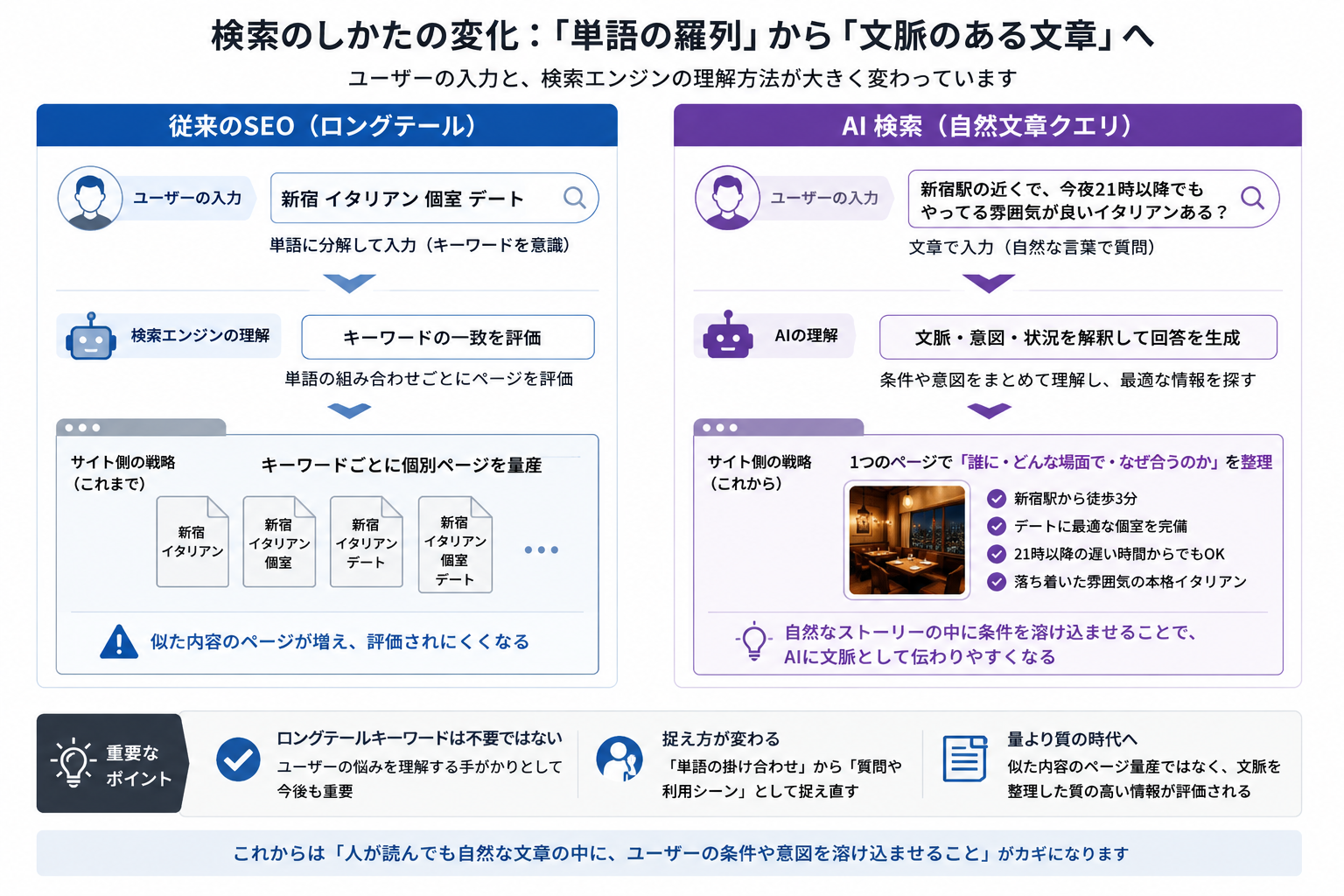
これまでのSEOと、これからのAI検索(GEO)では、 ユーザーの「検索のしかた」そのものが変わってきています。
|
従来のSEO(ロングテール) |
AI検索(自然文章クエリ) |
| 検索の入力方法 |
単語に分解して入力(例:新宿 イタリアン 個室 デート) |
文章で入力(例:新宿駅の近くで、今夜21時以降でもやってる雰囲気が良いイタリアンある?) |
| エンジンの理解 |
キーワードの一致を評価 |
文脈・意図・状況を解釈して回答を生成 |
従来のSEOでも検索意図や文脈は重要でした。 ただし実務上は、キーワード単位でページを設計し、検索結果上で評価を取りにいく考え方が中心でした。 その結果、条件の組み合わせごとにページを量産する戦略に一定の効果がありました。
一方でAI検索では、似た条件違いのページを大量に作るよりも、 1つのページ内で「誰に・どんな場面で・なぜ合うのか」を自然に整理する方が 文脈として伝わりやすくなる傾向があります。 もちろん、用途・対象・地域・商品カテゴリが明確に異なる場合は個別ページを作る意味があります。 問題なのは、実質的に同じ内容をキーワード違いだけで量産することです。
またロングテールキーワード自体が不要になるわけではありません。 むしろ、ユーザーの具体的な悩みを理解する手がかりとしては今後も重要です。 ただし、単語の掛け合わせとして扱うのではなく、 自然文の質問や利用シーンとして捉え直す視点が必要になってきています。 「新宿 イタリアン 個室 デート」は、 「新宿でデートに使える個室のイタリアンは?」という質問に変換して考えるイメージです。
これからの書き方のコツ
単語をただ箇条書きで埋め込むのはNGです。
「新宿駅から徒歩3分の当店は、デートに最適な個室を完備。 21時以降の遅い時間からでも、落ち着いた雰囲気の中で本格イタリアンをお楽しみいただけます」
のように、人間が読んでも自然なストーリーの中に条件を溶け込ませることが、 AIに文脈として伝わりやすくなります。
2. 同じ言葉でも「解釈」が変わる?AIが読み取るクエリの文脈
AI検索の興味深い進化のひとつは、同じクエリでも 位置情報・会話の流れ・ユーザーが入力した条件・サービス側の設定などをもとに、 回答が変わる場合があることです。
※以下は説明のための例です。実際にはここまで明快に分岐するとは限りませんが、 傾向として「同じクエリでも解釈が変わり得る」イメージとして読んでください。
例えば、次の2人のユーザーが同じクエリを入力したとします。
「渋谷でコスパがいい和食。土曜日にいく」
| ユーザーの背景 |
AIが解釈しやすいニュアンス |
提案されうるお店のイメージ |
| 接待が多いビジネスパーソン |
「この価格でこの空間とクオリティはお値打ち」という意味 |
落ち着いた雰囲気の大人向け和食(予算1万円台) |
| 学生・若い世代 |
「安くてお腹いっぱいになれる」という意味 |
コスパ重視の賑やかな和食居酒屋(予算3,000円台) |
従来のSEOでは、多くの場合「渋谷の和食おすすめ10選」のような 共通のまとめ記事が受け皿になっていました。 AI検索では、クエリの背景にある意図をより細かく解釈しようとする傾向があります。
ちなみに、同じ質問をChatGPT・Gemini・Perplexityに投げると、 返ってくる回答が違うことがあります。 以前はGoogleだけ見ていればよかったのが、今は複数のAIを意識する必要が出てきています。 各社のモデルや学習データ、情報取得の仕組みが異なるためですが、 どのAIがどういう基準で判断しているかは、2026年6月時点では公開されていない部分がほとんどです。 Genviewではこの「AIごとの回答の違い」を継続的に観測しながら、 何が影響しているかを解き明かしていくことを目標のひとつにしています。
3. やるべきことが「キーワード設計」から「ブランド定義と情報の一貫性管理」へ
ロングテールキーワードから自然文章クエリへの変化は、単なる入力方法の変化ではありません。 事業者側も、 「どのキーワードで集客するか」から 「自社は誰のどんな課題を解決する存在なのか」を ネット全体で一貫して伝える方向へ変わっていきます。
具体的に何が変わるか
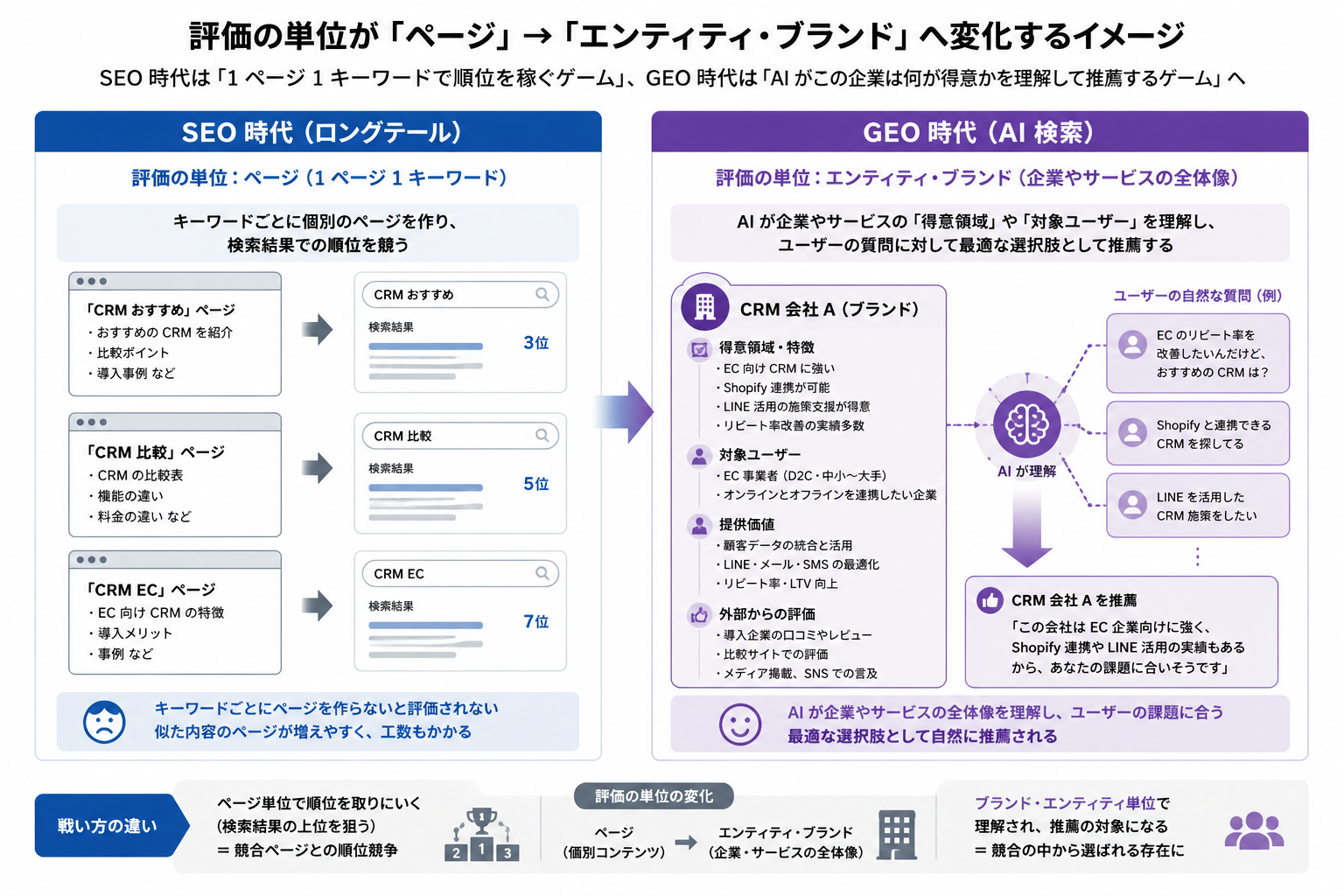
従来のSEOでは、キーワードごとにページを作り検索流入を獲得する発想が中心でした。
例えばCRMツールなら:
- 「CRM おすすめ」
- 「CRM 比較」
- 「CRM EC」
- 「CRM LINE連携」
一方でAI検索では、こういった課題ベースの質問が増えていきます。
- 「ECのリピート率を改善したい」
- 「LINEを活用したCRM施策をやりたい」
- 「Shopifyと連携できるCRMを探している」
AIはその質問に対して、「この会社は何が得意なのか」「どんな企業に向いているのか」 「競合と何が違うのか」を理解したうえで推薦しようとします。 そのため、これから重要になるのはキーワード単位の最適化ではなく、 ブランドやサービスの"定義"を明確にすることです。
SEO時代とGEO時代の対策の違い
|
SEO時代 |
GEO時代 |
| 対策の中心 |
検索ボリュームを調べる → キーワードを選定する → ページを作る → 順位を上げる |
誰向けなのかを明確にする → どんな課題を解決するか整理する → 競合との違いを定義する → その情報をネット全体で一貫して発信する |
| 評価の対象 |
ページ |
ブランド・サービス・企業 |
業種別の具体例
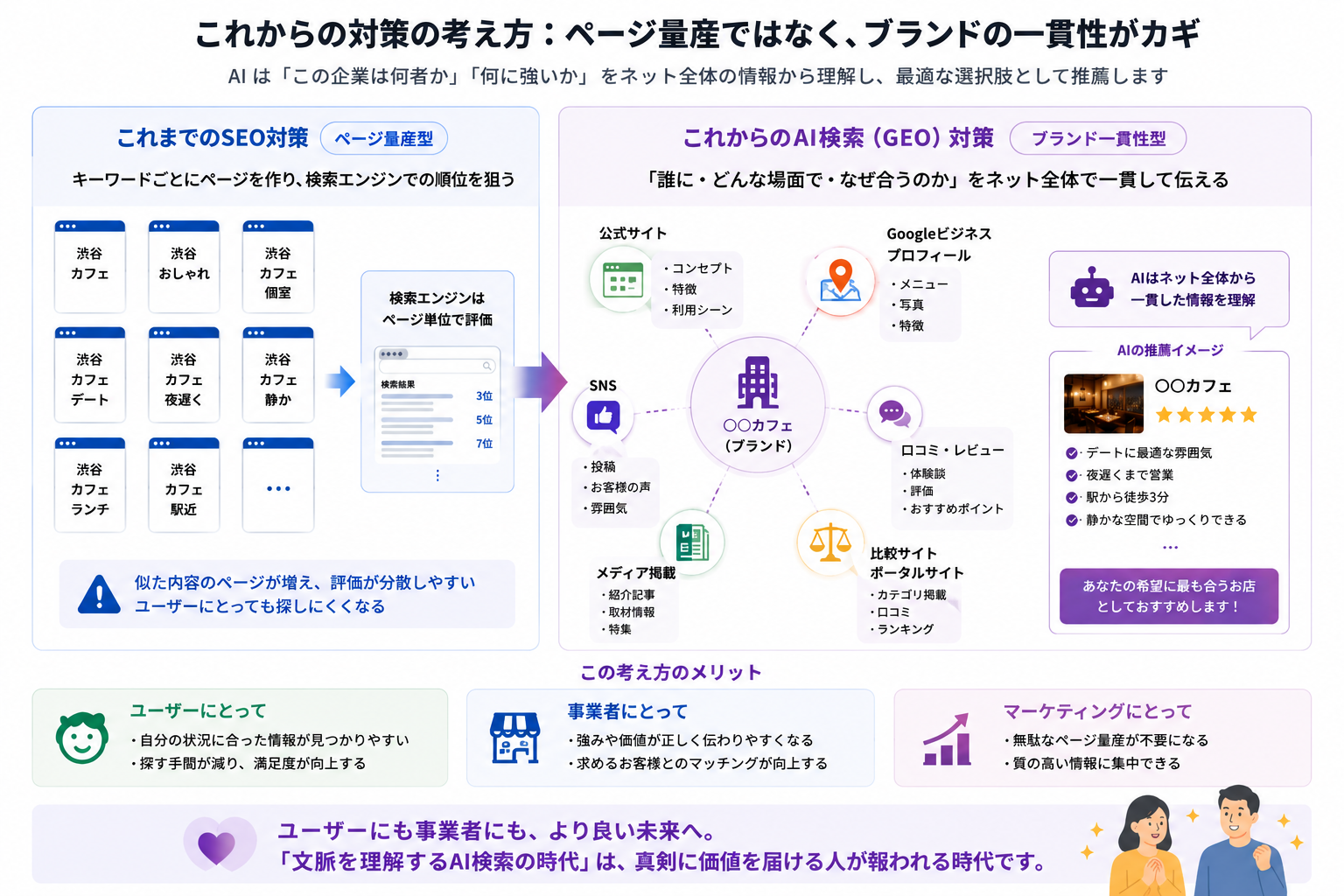
飲食店であれば「静かな個室がある」「接待向け」「大人向け」「コスパが良い」という情報を、 自社サイト・Googleビジネスプロフィール・口コミ・SNSなどで一貫して伝えることが重要になります。
BtoBも同じです。CRMツールであれば、EC向けなのか・BtoB営業向けなのか・ LINE活用に強いのか・Shopifyと連携できるのかを一貫して発信することで、 AIが「このサービスはこういう企業向けだな」と理解しやすくなります。
つまり、SEO時代が「検索されるキーワードを探すゲーム」だったとすれば、 GEO時代は「AIに正しく自己紹介するゲーム」に近いのです。
キーワード選定が不要になる話ではありません。 やるべきことが「キーワード設計」から「ブランド定義と情報の一貫性管理」へと 広がっていくイメージです。
4. これからの時代、私たちは何を対策すべきか?
「じゃあ、結局ホームページや店舗情報で何をすればいいの?」
その答えは、ページを量産することではなく、 「自社(自店)が、誰の、どんな状況(シーン)に寄り添えるのか」という 事実(属性情報)をネット上に一貫して整理しておくことです。
AIはページ単位で情報を評価するだけでなく、「この企業は何者か」「何に強いのか」「誰に向いているのか」といったブランド単位の理解を行おうとします。そのため、個別ページの最適化だけでなく、ネット全体で一貫したブランド定義が重要になります。
余談:個人的には、いい世界になると思っています
率直な感想を言うと、ロングテールで大量に作られた薄いコンテンツが意味をなさなくなって、 文脈で現在の希望を正確に打てば打つほどより正確な答えが返ってくる世界は、 とってもいいなと思っています。
上位表示を狙って作られた、何の意味もないページが減ることは、 ユーザーにとっても、真剣にコンテンツを作っている事業者にとっても、 良いことだと思っています。 SEOの量ゲームに疲れていた方には、特にそう感じていただけるんじゃないでしょうか。
SEO担当者が明日から始めるGEO対策アクションリスト
「考え方はわかった。で、明日から何をすればいい?」 SEO担当者向けに、すぐ動ける5つのアクションをまとめます。
-
自社サイトの「誰向け・どんな課題・どんな特徴」を1ページに明記する
「EC向け」「BtoB営業向け」「LINE活用に強い」など、 自社が解決できる課題と対象をはっきり書く。 曖昧な「高品質」「使いやすい」は避け、比較できる具体的な表現にする。
-
Googleビジネスプロフィールに「ターゲット・シーン」の情報を追加する
「静かな個室」「接待向け」「大人向け」など、 自社サイトと同じ文脈の表現をビジネスプロフィールにも反映させる。
-
口コミ・SNSで一貫した表現を意識する
自社サイトで使っている強みのキーワードが、 外部メディア・口コミ・SNSでも同じように登場しているか確認する。 バラバラな表現はAIの文脈理解を妨げる。
-
構造化データ(Schema)でエンティティ情報を追加する
@type: Organization・name・description・serviceなどを実装し、 自社が「何者か」をAIに機械可読な形で伝える。 コンテンツ整備の後に行う補強として位置づける。
-
月1回「AIが自社をどう認識しているか」をChatGPT・Geminiで確認する
自社名・サービス名・代表的な強みで質問し、 返ってくる回答が期待する文脈と一致しているかを確認する。 ずれていた箇所が「整えるべき箇所」になる。
特に⑤は今日から無料でできます。 まずAIに「自社について教えてください」と聞いてみることが、GEO対策の出発点です。
SEO担当者が誤解しやすいGEOの勘違い5選
GEO(生成エンジン最適化)が注目されるようになってから、さまざまな情報が飛び交っています。しかし、その中には少し極端な解釈も少なくありません。最後に、SEO担当者が特に誤解しやすいポイントを整理しておきます。
勘違い① SEOは終わる
結論から言うと、SEOは終わりません。AI検索も、Web上に存在する情報をもとに回答を生成しています。そのため、
- 検索エンジンに正しくクロールされる
- HTTPS化されている
- サイト構造が整理されている
- 構造化データが実装されている
といった基本的なSEO対策は、引き続き重要です。GEOはSEOの代替ではなく、SEOの上に積み上がる新しいレイヤーと考える方が正確でしょう。
勘違い② ロングテールキーワードは不要になる
ロングテールキーワード自体が不要になるわけではありません。むしろ、ユーザーがどんな悩みを持っているかを理解するための材料としては、今後も重要です。変わるのは捉え方です。これまでのように、
といった単語の組み合わせとして見るのではなく、
- ECのリピート率を改善したい
- Shopifyと連携できるCRMを探している
といった質問や利用シーンとして解釈する視点が求められます。
勘違い③ llms.txtを設置すれば勝てる
llms.txtは便利な仕組みですが、設置しただけでAIから推薦されるようになるわけではありません。AIは、
- サイト内容
- 外部評価
- 口コミ
- メディア掲載
- 情報の一貫性
なども含めて総合的に判断しています。llms.txtは「自己紹介を手伝う仕組み」のひとつであり、それ自体が評価を保証するものではありません。
勘違い④ AIに引用されたら成功
引用されることは重要ですが、それだけでは十分とは言えません。例えば、
- 名前だけ登場する
- 比較対象として一度だけ触れられる
場合と、
- おすすめ候補として推薦される
- 強みとともに紹介される
- 出典URL付きで紹介される
場合では価値が大きく異なります。重要なのは「引用されたか」だけではなく、どのような文脈で紹介されたかです。
勘違い⑤ 構造化データだけやればいい
構造化データ(Schema.org)は非常に重要です。しかし、それだけでAIがブランドを正しく理解するわけではありません。仮にOrganizationスキーマを実装しても、
- サイト内の説明
- 外部メディアの紹介
- SNSでの発信
- 口コミ
の内容がバラバラであれば、AIは何者なのか判断しづらくなります。構造化データは「機械が理解しやすくするための補助情報」です。本当に重要なのは、ネット全体で一貫したブランド情報を発信することです。
まとめ:AIに「選ばれる」存在になるために
|
従来のSEO(ロングテール) |
AI検索(GEO) |
| 検索の入力 |
ユーザーが検索エンジンに歩み寄った「単語の掛け算」 |
AIがユーザーの意図を解釈しようとする「文脈の読み取り」 |
| 対策の方向性 |
キーワードの網羅性(量) |
ユーザーの文脈への適合性(質・一貫性) |
| 評価の対象 |
ページ単位 |
ブランド・エンティティ・文脈単位 |
実は、GEOはSEOと真逆の考え方ではありません。検索意図を理解し、ユーザーに役立つ情報を提供するというSEOの本質はそのままです。変わったのは、評価対象が「ページ」から「ブランド」へ広がったことです。
その上で、これからのWebマーケティングは、 キーワードの量を競うゲームに加えて、 「自社が誰のためにあるのか」という文脈の一貫性を ネット全体で整えていく視点が重要になってきます。 ただし、基本的なSEO対策(サイト構造・HTTPS・構造化データなど)は引き続き重要です。 Genviewでは、こうした技術的な実装状況の診断から、AIが自社をどう認識しているかの監視まで、 GEO対策に必要な一連の確認と改善をサポートしています。
あなたのサイトや店舗情報は、AIから見て「誰のための場所」か明確になっていますか? 今一度、発信している文脈を見直してみましょう。
GEOの基本的な考え方については、 GEOとは?AIに選ばれるブランドのための生成エンジン最適化入門や AI検索で何が変わるのかもあわせてご覧ください。
Note: This article intentionally simplifies some aspects of AI search and SEO in order to explain the difference clearly. In practice, optimization involves many more factors, but this article prioritizes helping readers understand the shift in thinking.
Introduction
Are you starting to feel the limits of SEO strategies that combine multiple keywords like “Shibuya cafe recommended” and produce many similar pages?
Thin, mass-produced content pages have become harder to evaluate positively than before. At the same time, the spread of AI search is changing how search intent itself should be understood.
This article answers one of the most common questions asked when discussing GEO strategy: “What is the difference between long-tail keywords and natural-language queries in AI search?” It also explains how web strategy needs to evolve from here.
This does not mean SEO will be completely replaced by GEO. A more accurate view is that GEO sits on top of SEO. Fundamental SEO practices remain important.
1. From “Lists of Words” to “Context-Rich Sentences”
The way users search is changing between traditional SEO and AI search, or GEO.
|
Traditional SEO (Long-tail) |
AI Search (Natural-language Queries) |
| Input style |
Users break intent into keywords, such as “Shinjuku Italian private room date” |
Users ask in sentences, such as “Is there a nice Italian restaurant near Shinjuku Station that is open after 9 p.m. tonight and good for a date?” |
| How the engine understands it |
Evaluates keyword matching |
Interprets context, intent, and situation to generate an answer |
Even in traditional SEO, search intent and context were important. In practice, however, many strategies were centered on designing pages around individual keywords and trying to win rankings in search results. As a result, creating pages for different combinations of conditions had a certain level of effectiveness.
In AI search, however, rather than creating large numbers of pages with slightly different conditions, it is often easier to convey context by organizing information naturally within a single page: who it is for, in what situation, and why it fits. Of course, when use cases, audiences, regions, or product categories are clearly different, creating separate pages still makes sense. The problem is mass-producing pages that are essentially the same except for keyword variations.
Long-tail keywords themselves will not become unnecessary. In fact, they will remain important as clues for understanding users’ specific concerns. However, they need to be reframed not as combinations of words, but as natural-language questions and usage scenarios. For example, “Shinjuku Italian private room date” should be considered as a question like “What Italian restaurants in Shinjuku have private rooms and are suitable for a date?”
Writing Tips for the AI Search Era
Simply stuffing keywords into bullet points is not effective.
For example:
“Located three minutes on foot from Shinjuku Station, our restaurant offers private rooms ideal for dates. Even after 9 p.m., you can enjoy authentic Italian cuisine in a calm atmosphere.”
Embedding conditions into a natural story that humans can read comfortably also makes it easier for AI to understand the context.
2. Can the Same Words Be Interpreted Differently? How AI Reads Query Context
One interesting development in AI search is that even the same query may produce different answers depending on location, conversation flow, conditions entered by the user, and settings on the service side.
The following is an explanatory example. In practice, the branching may not be this clear-cut, but it illustrates how the same query can be interpreted differently depending on context.
Suppose two users enter the same query:
“Good-value Japanese restaurant in Shibuya for Saturday.”
| User background |
Nuance AI may interpret |
Type of restaurant that may be suggested |
| Businessperson who often entertains clients |
“Good value considering the atmosphere and quality at this price” |
Calm, adult-oriented Japanese restaurant with a budget around ¥10,000 |
| Student or younger user |
“Cheap and filling” |
Lively Japanese izakaya focused on value, with a budget around ¥3,000 |
In traditional SEO, a common roundup article like “Top 10 recommended Japanese restaurants in Shibuya” often served as the destination. AI search, however, tends to interpret the intent behind the query in more detail.
Also, if you ask the same question to ChatGPT, Gemini, and Perplexity, the answers may differ. In the past, watching Google alone was often enough, but now multiple AI systems need to be considered. This is because each company’s model, training data, and information retrieval mechanisms differ. However, as of June 2026, most of the criteria each AI uses to make these judgments remain undisclosed. One of Genview’s goals is to continuously observe these differences in AI responses and help clarify what may be influencing them.
3. From “Keyword Design” to “Brand Definition and Information Consistency Management”
The shift from long-tail keywords to natural-language queries is not merely a change in input style. Businesses also need to move from “which keywords should we target?” toward consistently communicating across the web who they are and what problems they solve for whom.
What Specifically Changes?
In traditional SEO, the central idea was to create pages for each keyword and acquire search traffic.
For example, for a CRM tool:
- “CRM recommended”
- “CRM comparison”
- “CRM EC”
- “CRM LINE integration”
In AI search, however, more problem-based questions will appear.
- “I want to improve repeat purchase rates for an EC business.”
- “I want to use LINE for CRM campaigns.”
- “I am looking for a CRM that integrates with Shopify.”
AI tries to recommend a company after understanding what it is good at, what kinds of businesses it is suited for, and how it differs from competitors. Therefore, what becomes important is not keyword-level optimization alone, but clearly defining the brand or service itself.
Differences Between SEO-Era and GEO-Era Strategies
|
SEO Era |
GEO Era |
| Main focus |
Research search volume → select keywords → create pages → improve rankings |
Clarify who it is for → define what problems it solves → define differences from competitors → communicate that information consistently across the web |
| Unit of evaluation |
Page |
Brand, service, company |
Examples by Industry
For restaurants, it becomes important to consistently communicate information such as “quiet private rooms,” “suitable for business dinners,” “adult-oriented,” and “good value” across the official site, Google Business Profile, reviews, and social media.
The same applies to BtoB. For a CRM tool, consistently communicating whether it is for EC businesses, BtoB sales, LINE-based CRM, or Shopify integration makes it easier for AI to understand what type of company the service is suited for.
In other words, if SEO in the past was a game of finding keywords that people search for, GEO is closer to a game of introducing yourself correctly to AI.
This does not mean keyword research becomes unnecessary. Rather, what needs to be done expands from “keyword design” to “brand definition and information consistency management.”
4. What Should We Optimize for From Now On?
“So what should we actually do on our website or business listings?”
The answer is not to mass-produce pages. It is to consistently organize factual attributes across the web: who your company or store is for, and in what situations it can help.
AI does not only evaluate information at the page level. It also tries to understand brands at a broader level: what this company is, what it is strong at, and who it is suited for. Therefore, in addition to optimizing individual pages, a consistent brand definition across the web becomes important.
A Personal Note: I Think This Is a Good Direction
Honestly, I think a world where thin, mass-produced long-tail content loses its meaning, and where more precise contextual questions lead to more accurate answers, is a very good thing.
A reduction in meaningless pages created purely to rank higher is good for users and for businesses that are seriously creating meaningful content. If you have been tired of the volume game in SEO, this shift may feel especially refreshing.
GEO Action List for SEO Professionals to Start Tomorrow
“I understand the concept. But what should I do starting tomorrow?” Here are five actions SEO professionals can take immediately.
-
Clearly state “who it is for, what problem it solves, and what makes it different” on one page of your website.
Write clearly what problems you can solve and for whom, such as “for EC businesses,” “for BtoB sales,” or “strong in LINE utilization.” Avoid vague expressions like “high quality” or “easy to use,” and use concrete phrases that can be compared.
-
Add target audience and usage scene information to your Google Business Profile.
Reflect the same contextual expressions used on your website, such as “quiet private rooms,” “for business dinners,” or “adult-oriented,” in your business profile as well.
-
Maintain consistent wording in reviews and social media.
Check whether the keywords representing your strengths on your site also appear consistently in external media, reviews, and social media. Scattered expressions can make it harder for AI to understand the context.
-
Add entity information using structured data (Schema).
Implement information such as @type: Organization, name, description, and service to communicate what your company is in a machine-readable format. Treat this as reinforcement after content has been organized.
-
Once a month, check how AI recognizes your company using ChatGPT and Gemini.
Ask about your company name, service name, and representative strengths, then check whether the answers match the context you expect. Any mismatch becomes an area that needs to be organized.
Action 5 can be done for free starting today. Asking AI, “Tell me about our company,” is the starting point for GEO strategy.
5 Common GEO Misconceptions Among SEO Professionals
As GEO, or Generative Engine Optimization, has gained attention, various information has started circulating. However, some interpretations are too extreme. Here are five points SEO professionals commonly misunderstand.
Misconception 1: SEO Is Over
In short, SEO is not over. AI search also generates answers based on information that exists on the web. Therefore, fundamental SEO practices remain important, such as:
- Ensuring search engines can crawl your site correctly
- Using HTTPS
- Organizing site structure
- Implementing structured data
GEO is not a replacement for SEO. It is more accurate to think of it as a new layer built on top of SEO.
Misconception 2: Long-Tail Keywords Will Become Unnecessary
Long-tail keywords themselves will not become unnecessary. In fact, they remain important as materials for understanding what problems users have. What changes is how they are interpreted. Rather than seeing them as combinations of words such as:
- CRM recommended
- CRM comparison
- CRM EC
they need to be interpreted as questions or usage scenes such as:
- I want to improve repeat purchase rates for an EC business.
- I am looking for a CRM that integrates with Shopify.
Misconception 3: Installing llms.txt Means You Win
llms.txt is a useful mechanism, but simply installing it does not mean AI will begin recommending your brand. AI considers many factors, including:
- Website content
- External evaluations
- Reviews
- Media coverage
- Information consistency
llms.txt is one mechanism that helps introduce your site. It does not guarantee evaluation by itself.
Misconception 4: Being Cited by AI Means Success
Being cited is important, but it is not enough by itself. For example, there is a major difference between cases where:
- Your name appears once
- You are briefly mentioned as a comparison target
and cases where:
- You are recommended as a candidate
- Your strengths are introduced
- You are mentioned with a source URL
What matters is not only whether you were cited, but in what context you were introduced.
Misconception 5: Structured Data Alone Is Enough
Structured data, or Schema.org, is very important. However, it does not make AI understand a brand correctly by itself. Even if Organization schema is implemented, if the following information is inconsistent, AI may struggle to determine what the brand actually is:
- Descriptions on the website
- Introductions in external media
- Social media posts
- Reviews
Structured data is supporting information that helps machines understand content more easily. What truly matters is consistently communicating brand information across the web.
Conclusion: Becoming a Brand AI Chooses
|
Traditional SEO (Long-tail) |
AI Search (GEO) |
| Search input |
“Multiplication of words” where users adapt to the search engine |
“Context interpretation” where AI tries to understand user intent |
| Optimization direction |
Keyword coverage, quantity |
Fit with user context, quality, consistency |
| Unit of evaluation |
Page level |
Brand, entity, and context level |
GEO is not the opposite of SEO. The essence of SEO—understanding search intent and providing useful information to users—remains unchanged. What has changed is that the unit of evaluation has expanded from pages to brands.
From now on, web marketing needs to move beyond competing only on keyword volume and begin organizing consistent context across the web around the question: “Who is our company for?” At the same time, fundamental SEO practices such as site structure, HTTPS, and structured data remain important. Genview supports the series of checks and improvements needed for GEO, from diagnosing technical implementation status to monitoring how AI recognizes your company.
From AI’s perspective, is your website or business information clear about who it is for? It may be time to review the context you are communicating.
For the basics of GEO, please also see our articles on what GEO is and our introductory guide to GEO.